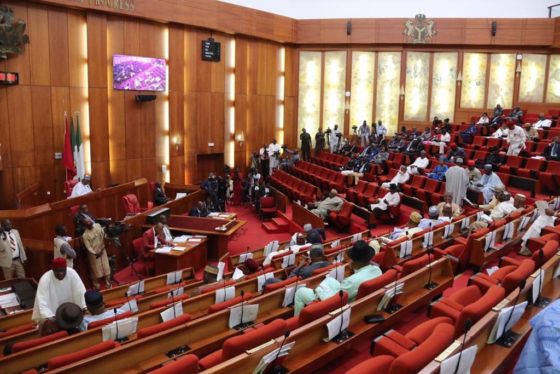
Nigerian Senate By Yinka Odumakin W E have spent the last three weeks examining the major contentious issues in our Constitution and re...
By Yinka Odumakin
WE have spent the last three weeks examining the major contentious issues in our Constitution and recommendations of the 2014 National Conference. I have read the el-Rufai committee’s reports and its recommendations are similar in so many respects.
The 2014 reports have over 600 recommendations which were adopted unanimously as the ballot boxes were not used once.
I learnt of one state in the Northern part of the country that organised elections into its local government with elaborate preparations. One of the key things done was to set up a committee to go and procure ballot boxes abroad.
The committee travelled out and sourced high quality boxes befitting such exercise. But before it returned to the country the election had taken place and winners have been sworn in. In our own case, the boxes were provided but were never used because of unanimity.
The committee will find many recommendations on policy issues that are not contentious but very useful for the future of the country. Once we acquired the hardwares discussed in the past three weeks, the rest would just be softwares. Some of the recommendations are even being implemented already such as 1PPIS:
- Conference decided that:
- The Integrated Personnel and Payroll Information System, IPPIS, be fully implemented to ensure payroll integrity and eliminate ghost workers in the Civil Service, Parastatals, the Legislature, the Judiciary, the Military and the Para-Military; and
- While it is appreciated that the nature of presidential system of government necessitates the appointment of ‘Special Advisers’ and ‘Special Assistants’ to the President, the Vice President, the Governor and the Deputy Governor, its extension to Ministers, Commissioners and Local Government Chairmen should be discontinued as a cost-saving measure. These categories of political office holders should utilise the staff of their Ministries where it becomes necessary as contained in Circular Ref. No. B63833/73 of January 3, 2000.
- Budgeting and Public Expenditure Reforms Conference decided that:
- A national framework for monitoring and evaluating budget performance should be established;
- Budget performance targets should be set for MDAs;
- Civil society organisations should be encouraged to independently track implementation of programmes and projects;.
The rest of this part will do us some good. The only issue that I still think is very germane to point out is the issue of immunity for public officials as there are even now discussions going on about extending such to principal officials of the National and State Assemblies. The issue was discussed at length in 2014 and this was the position taken:
IMMUNITY CLAUSE
Conference decided that:
- (i) The immunity in civil and criminal matters as enshrined in Section 308 of the Constitution for certain public officers should be removed;
- (ii) Where corruption cases are brought against these public officers, Conference decided that the investigation of these cases be done outside the ordinary criminal processes. In this case, Conference recommended the establishment of the office of an Independent Grand Jury, IGJ, as follows:
1.(a) Where the allegation of misconduct relates to any form of crime as defined by any act of the National Assembly or a law of a state, that allegation must be accompanied with a sworn affidavit;
- (b) The sworn affidavit must be presented to the Attorney General of the Federation stating that the holder of the office of President or Vice President is guilty of such a crime;
- (c) The Attorney General of the Federation shall within seven days of receipt of the petition appoint an Independent Grand Jury to investigate the matter. Where the Independent Grand Jury establishes a prima facie case against the President, the report should be submitted to the National Assembly to commence the process of removal from office as provided in Section 143 of the Constitution;
- (d) The above process should be inserted as a new provision in the Constitution, Section 143 of the Constitution and should apply similarly to the provision of Section 188 dealing with the removal of State Governors and Deputy Governors;
5.(e) Duties of the IGJ:
1.(i)Initiating and conducting a thorough investigation and handling all aspects of any case referred to it by the Attorney General of the Federation with a view to proving or disproving the allegation(s); and
- (ii) It shall have the powers of a Judicial Commission of Inquiry
(iii). Qualifications of the Independent Grand Jury.
READ ALSO: We are empowering women as catalysts for change — Herbert Wigwe
Conference decided that:
The independent Grand Jury should consist of :
1.(a) A serving Justice of the Court of Appeal who shall be the chairman;
- (b) Six other persons who in the opinion of the Attorney-General of the Federation are of unquestionable integrity, not being members of any public service, legislative house or political party; and
- (c) None of the members of the Independent Grand Jury, including the chairman shall be from the same state of origin or in the case of a Governor or Deputy Governor the same Senatorial district as the officer being investigated.
- (iv) Conference decided that the expenses of the Independent Grand Jury should be a direct charge to the Consolidated Revenue Fund of the Federation or of the State as the case may be.”
If this exercise is carried out with the best of intentions, you will get to the point the conference reached in Chapter 7:
7.2 DEBATE ON MODALITIES FOR IMPLEMENTATION OF CONFERENCE RESOLUTIONS
In the course of determining the modalities for the implementation of Conference Resolutions, different shades of opinion emerged from the Delegates, to wit:
(a) Amendments to the Constitution which are proposed by the Conference should be embedded into the 1999 Constitution and the resultant document should be regarded as the 1999 Constitution (as amended);
(b) The Volume of Amendments embedded in the 1999 Constitution would make it a new document which should be regarded as making it a new constitution.
Constitutional process
7.2.1 If Conference decides that it is a 1999 Constitution (as amended), then the process of bringing it into being will be through the normal constitutional process as envisaged in the 1999 Constitution.
7.2.2 However, if Conference decides that the resultant document is a brand new constitution, then to bring it into existence will necessitate a referendum.
7.2.3 Conference is still to take a decision on whether it will be a 1999 Constitution (as amended) or a brand new Constitution at the close of plenary on Thursday, July 10, 2014.”
If we want a constitution that can truly answer “We, the people”, an amended constitution may be insufficient. As lawmakers you have no power to write a new constitution but you can facilitate the process and work on fundamentals like referendum, et al.
Generals Yakubu Gowon and Olusegun Obasanjo who played key roles in delivering the country have warned this country lately to deal with its structures to avoid another war; you have the golden chance to avert that course of destruction NOW.
The post Memo to Senate Committee on Constitution (4) appeared first on Vanguard News.


No comments